TU – Großbaustelle am Ernst-Reuter-Platz
Text by Francesco Di Prisco
1. Introduction: Encountering an Archival Object
The archival footage Großbaustelle am Ernst-Reuter-Platz represents a classic example of an archival object. The film was produced to document the massive construction and expansion works of the Technische Universität (TU) Berlin. Its status as an artifact and its typological placement, however, generate certain ambiguities. The recorded material, in fact, occupies a gray area between documentary, television material, and historical residue. In the in-depth analysis of this document, it is therefore essential to ask whether this footage is merely informative or whether it still functions today as a specific historical object of post-war modernization and institutional expansion in Cold War West Berlin.
The material has a duration of 3 minutes and 18 seconds and was originally broadcast on 24 July 1964 by SFB (Sender Freies Berlin). Today, the footage is accessible and preserved in digital format on the ARD Mediathek website of the German public broadcasting service, as part of the rbb Retro – Berliner Abendschau series. The original film material is preserved in DRA (Deutsches Rundfunkarchiv), the German Radio and Television Archive.
On the basis of the available data and information, the following sections will analyze these archival images by highlighting their material, visual, and contextual properties, as well as their relevance and function in the present.
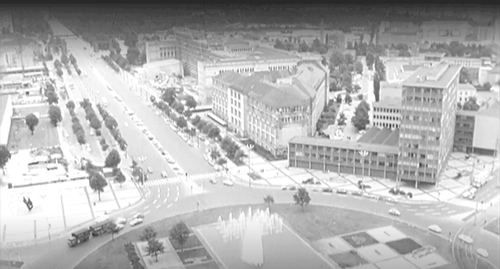
0:04 min: Aerial View of Ernst-Reuter-Platz
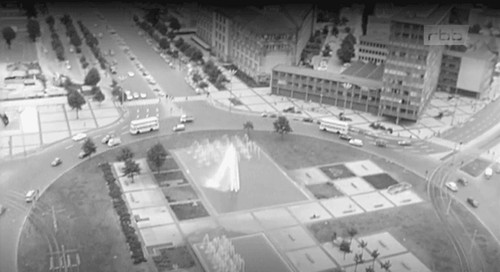
03:16 min: Aerial View of Ernst-Reuter-Platz
2. First Impressions and Description of the Document
Thirty different black-and-white shots compose the entire document. Accordingly, the editing follows a circular structure that returns to the bird’s-eye view of Ernst-Reuter-Platz (West Berlin). The aesthetic follows that of a typical 1960s journalistic report with images having a functional and explanatory value. In this case, a contrast of natural light and film grain is responsible for the reduced sharpness. Signs of aging in the filmed material have been restored through digitalization. However, voice-over narration is almost entirely complementing the original audio from the construction site. The limited ambient sound is not generating emotional engagement, but rather supporting the descriptive and observational tone. The archival footage’s journalistic voice over adopts a rhetorical tone.
To this style is added a formal, informative, and authoritative nuance. The objective is to guide the viewer by emphasizing technological progress and the efficiency of the construction techniques employed in West Berlin. The university expansion is represented as a forward-looking modernization project.
The footage shifts between different macro sections filmed. Construction machinery shown in motion, scaffolding and particular attention to unfinished buildings. Workers performing repetitive tasks inside the construction site with a substantial absence of identifiable individuals or personal stories. View of the construction site displayed in relation to the already existing buildings, within the large-scale urban space of Ernst-Reuter-Platz.
3. Archival status and Mediated Access
For the purpose of this analysis, the footage was consulted in its digital format through the ARD Mediathek platform. However, the original film material is preserved in physical form at the Deutsches Rundfunkarchiv (DRA), where the film rolls can be accessed upon request. As already described in the introduction, the document is part of the rbb Retro – Berliner Abendschau.
This particular section, realized for Rundfunk Berlin-Brandenburg (rbb), constitutes a sort of journey through time via historical reports from the 1950s, 1960s, and subsequent years. The program focuses on daily life, reconstruction, and events in the neighborhoods of West Berlin. However, the recorded material was part of an original live broadcast of the television news program Berliner Abendschau. The peculiar aspect of interest in the footage is the change of function over time: from a journalistic news report to a historical source that testifies the evolution of the German capital. As matters now stand, this interesting document becomes an object of study, rich in historical evidence.
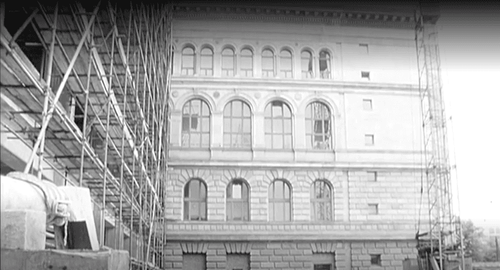
02:12 min: Contrast Between Old and New Structures.
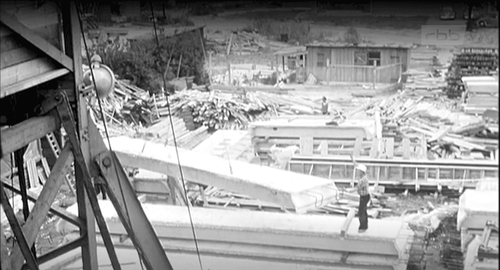
00:37 min: Construction Machinery in Motion.
4. Contemporary Relevance and Historical Significance
Großbaustelle am Ernst-Reuter-Platz (1964) documents the period following the Second World War. Post-war West Berlin is a place where the focus is on the reconstruction and modernization of large areas. During 1960, the context of the Cold War outlined Berlin as an urban unicum. The construction of the Berlin Wall in 1961 contributed to making West Berlin an isolated enclave of the FRG surrounded by territories of the GDR.
The urban development documented by this report was dictated not only by practical necessities but also by symbolic demonstrations. Modernization was represented as a symbol of Western progress, technological advancement, and political stability.
In a city undergoing transformation, the expansion works of the TU at Ernst-Reuter-Platz during the 1960s acquired symbolic and morphological value. In the context of divided Berlin during the Cold War, the expansion of the Technische Universität also functioned as a symbolic demonstration of Western technological progress.
On the ARD Mediathek website dedicated to this archival footage, the massive intervention is described as: Baumaßnahmen für die Technische Universität verändern das Stadtbild (Construction measures for the Technical University are changing the cityscape). The voice-over present in the footage also emphasizes the technological innovations employed in this construction site. However, in the final part, the description of the report focuses on the possible rising student numbers and limited construction space.As evidenced by the description of the video in digital format, a strong ideology of productivity and technological progress can be perceived. Indeed, the expansion of the campus of this West German university is prepared to do without the old buildings that must make way for new and technologically advanced structures. The repeated focus of the images on the details of the machinery used, the concrete mixers, the reinforced concrete floors, and the steel, provides tangible evidence. This situation highlights the architectural and urban relevance of the works, demonstrated by the relationship between the already existing university building and the new construction site depicted in the shots.
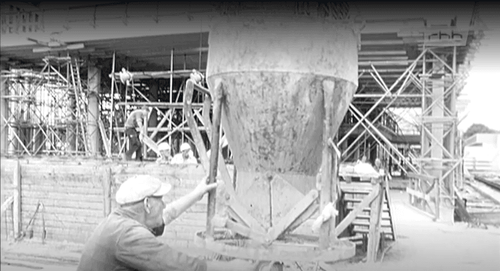
00:42 min: Worker utlizing the concrete technique.
In the contemporary viewing of this vintage news report, an important historical and visual testimony can therefore be perceived. Although the journalistic report appears to be primarily addressed to an audience of 1964, a future historical relevance and modernist rhetoric is already present within it. Indeed, as explained in the description of the footage on the ARD Mediathek website, the completion of the works was planned for the 2000s (Bis zum Jahr 2000 soll der Ausbau der Universitätsstadt am Ernst-Reuter-Platz abgeschlossen sein). This is an important detail that places the archival footage itself, already at the moment of its original broadcast, within a historical perspective. It thus constitutes a source from which to obtain significant material for urban, architectural, everyday-life, and media culture research.
5. Conclusion
Considering the conclusions reached, the film today represents not only a reportage but an extremely important historical object. In the contemporary analysis, a transformation of significance is witnessed: from a document part of a 1964 TV show to a statement of modernization and ideology of progress in West Berlin. Therefore, the voice-over narration, the machinery, the relationship between old and new parts of Ernst-Reuter-Platz help define a utopian image of modernity. The digital access with ARD Mediathek combined with the physical footage kept in Deutsches Rundfunkarchiv, has an important relevance in the architectural and institutional evolution of the TU. This footage is a nice example of how archival objects are dynamic entities, capable of changing meanings through the decades and offering multiple interpretations.
Reference sources
Rundfunk Berlin-Brandenburg. (1964, 24 luglio). TU Berlin: Großbaustelle am Ernst-Reuter-Platz [Video]. ARD Mediathek. https://www.ardmediathek.de/video/rbb-retro-berliner-abendschau/tu-berlin-grossbaustelle-am-ernst-reuter-platz/rbb/Y3JpZDovL3JiYi1vbmxpbmUuZGUvYmVybGluZXItYWJlbmRzY2hhdS8xOTY0LTA3LTI0VDE5OjMwOjAwX2QzZGM4NTgwLTNiYzAtNGE1NC04NmZhLTQ0MzRjYjlhYjM3Yy9yZXRyb18xOTY0MDcyNF9UVS1Hcm9zc2JhdXN0ZWxsZQ
1964
3:18 min
Regie
ARD Mediathek: Link