August Borsig – Wegbereiter des Massenverkehrs
Text by Francesco Di Prisco
1. Introduction: Encountering an Archival Object
August Borsig – Wegbereiter des Massenverkehrs is a 1983 film produced in West Berlin. Today, the original footage is preserved in physical format at the Landesarchiv Berlin. The archival material under analysis consists of a 16mm color analog positive film preserved on a single reel.
In the archival catalogue, the film is registered under the reference number 02557 (preliminary number 2042) within the collection of 8 and 16mm films. The length of the digitized version of this educational film is twenty-six minutes and twenty-six seconds. The film originates from the institutions Landesbildstelle Berlin and Berlin Info West, which are listed in the archival record as the provenance of the material
This documentary directed by Jürgen Haase can be divided into two macro sections. The first describes the historical contribution of August Borsig(1804-1854) as a pioneer of locomotives, mass transportation, and industrialization. The second focuses on the research and innovations on transportation conducted at the Technische Universität Berlin.
On the basis of the available data and information, the following sections will analyze these archival images by highlighting their material, visual, and contextual properties, as well as their relevance and function in the present.
2. Archival status and Mediated Access
The initial introduction outlines the key archival coordinates regarding this documentary. The holdings of the Landesarchiv Berlin preserve the film within the collection of 8mm and 16mm films. This archive located in the Reinickendorf area guarantees the preservation of approximately 3,800 film reels filmed in a period between 1895 and 2005.
The Landesarchiv’s cataloguing method enables the exact identification of the archival unit. The archival reference number and the preliminary number enable researchers to locate the document within the archival collection.
The film’s provenance is another key factor in the cataloging of the reels in the archive. This 1980s documentary is specified to have originated from two institutions of origin: Landesbildstelle Berlin and Berlin Info West.
The consultation of this 1983 West German documentary is also made possible through a digitized version. Digital access allows wider availability for research, while the original analog film remains preserved within the archive.
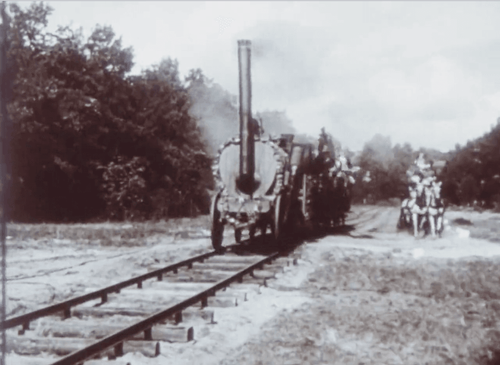
10:30 min: Frame from the 1934 film comparing a locomotive and a horse-drawn carriage.
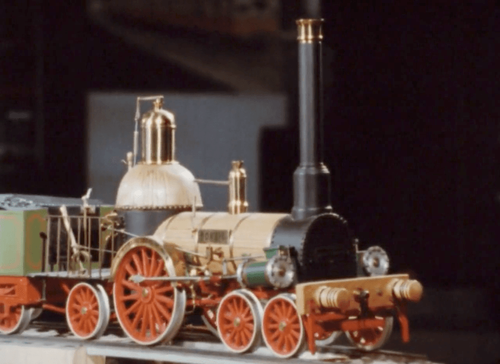
05:41 min: Borsig-branded locomotive model
3. First Impressions and Description of the Document
As previously mentioned in the introduction, this archival film is a color educational documentary from the early 1980s and it is composed of two main sections. This movie is a result of a Multimedia Berlin production, under the supervision of Frank Thorras. Overall, the documentary follows a chronological narrative structure, beginning with a brief three-minute introduction.
In the first part of the film, Jürgen Haase combines historical material, documents, paintings, and excerpts from the 1934 film Die Liebe und die erste Eisenbahn. The second part, instead, focuses on contemporary footage of public transportation in Berlin during the 1980s as well as experiments conducted in laboratories at the Technische Universität Berlin (TU).
Color footage is used more prominently in the second part of the film. The clear explanatory documentary style defines the voice-over narration and guides the viewer through the historical and technological developments presented in the film. Industrial landscapes and technical environments are combined with archival photographs, historical images, and documents, creating illustrative visual sequences.
A total of 252 different shots depict factories, locomotives models, machinery in details, research laboratories, and technological innovations related to the development of modern transportation systems in West Berlin.
4. Contemporary Relevance and Historical Significance
Nineteenth-century industrialization in Berlin was centered on the pioneering vision of August Borsig. Born in Breslau (today Wrocław) in 1804, the German entrepreneur and founder of the eponymous factory marked a pivotal role in the development of mass transport in central Europe. The advancements in railway technology redefined both the economic and urban landscape in Prussia’s process of industrialization. He is credited with the construction of the Beuth, as described by the voice-over: the first locomotive entirely produced in Germany. However, since the documentary is presented in German and no official transcript or subtitles are available, the present analysis focuses primarily on the visual structure and narrative function of the voice-over rather than on a detailed linguistic analysis of its content.
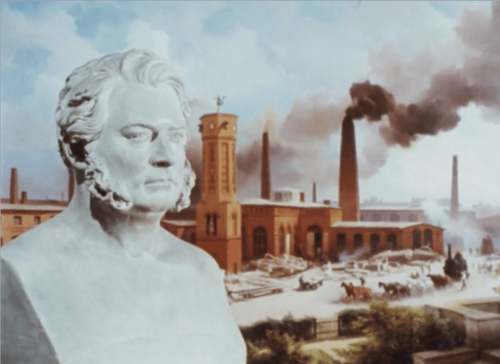
09:39 min: Bust of August Borsig with a painting of the factory in the background.
18:55 min: Hydro bus model on the road ...
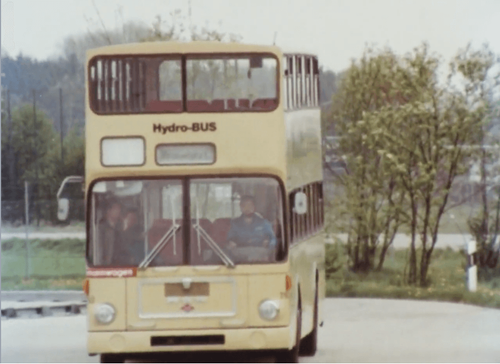
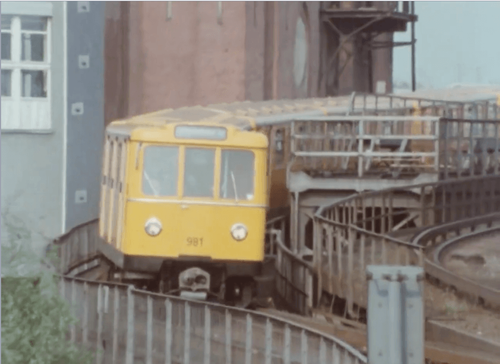
14:48min: ... and U-Bahn in the urban context.
In his portrayal of this figure, Jürgen Haase moves among paintings sketching the city's nineteenth-century industrial landscape. The focus is on the representations of the Borsig industrial complex in 1847, depicted from various angles. Indeed, the director frequently employs zoom-in and zoom-out movements to highlight minute details alongside panoramic views within these highly detailed paintings. The same technique is applied to the technical details of locomotives, archival documents and blueprints, as well as portraits and busts depicting Borsig.
In this second part and starting from minute 12, sequences are divided into four main sections. The exterior shots featuring the U-Bahn and buses in motion outline the relationship between public transport and the urban context of West Berlin. The designers at the TU, engaged in discussions about new models of metropolitan transport and hydrogen-powered buses, describe a constantly innovative approach adopted by the western progressive technicians. The TU scientists are also shown conducting crash tests aimed at optimizing safety measures and preventing deaths in road accidents.
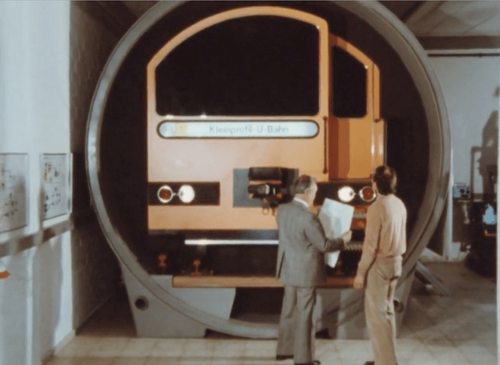
16:06 min: designers discussing an U-Bahn model.
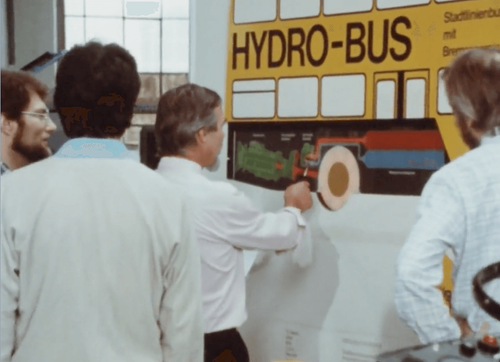
18:37 min: Designers discussing the Hydro bus model.
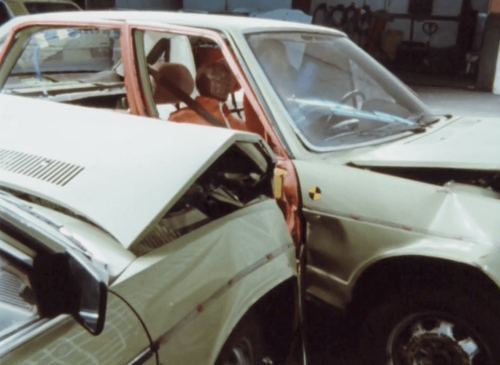
21:52 min: Crash test frame.
Haase chooses to alternate these scientific contexts with close-ups of drivers and passers-by. An interesting detail emerges from the analysis of these shots: the percentage of women actively present in the scenes is minimal. However, at the end of minute twenty-three the film concentrates on a female subject, and it is precisely when she is used as a test subject in a drunk-driving experiment. This imbalance reflects the gendered representation of technological professions, which were predominantly portrayed as male domains in the industrial and scientific discourse of the period.
However, it is important to observe another significant aspect that marked the 1980s. In the context of the height of the Cold War, West Berlin was represented as a technological showcase of innovation. Within this Western and progressive narrative, it was therefore fundamental to culturally appropriate the figure of August Borsig. Indeed, the entrepreneur Borsig had initially built his first factory in 1837 on Chausseestraße in the Mitte area. Only subsequently did he decide to expand his activities into the western part: to Moabit in 1847 and Tegel in 1898 (long alfter the entrepreneur’s death).
This historical fallacy demonstrates the necessity of establishing a partially fictitious common thread between Borsig’s industrial contribution and the innovation of the 1980s West Berlin.
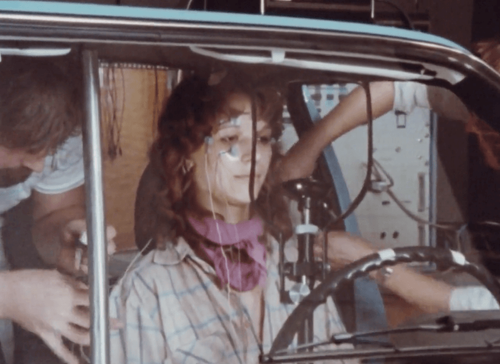
23:50 min: Female test subject for drunk driving experiment.
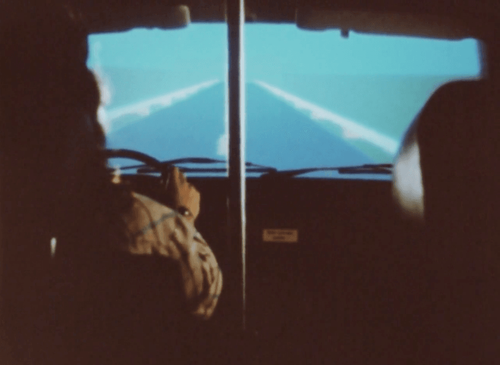
24:10 min: View of the driving simulator.
5. Conclusion
In conclusion, the preservation of this archival object in the Landesarchiv Berlin contributes to giving this 1983 film a value that goes beyond the merely documentary one. Haase focuses on the historical role of Borsig in the industrialization of Berlin in the nineteenth century and on the technological research carried out by the designers and scientists of the TU.
Its primary function as an educational documentary undergoes an evolution. Today, the August Borsig – Wegbereiter des Massenverkehrs documentary can be studied in digital format as a historical and visual source of West Berlin in the 1980s.
The critical eye of the twenty-first century thus offers the researchers the possibility to analyze this document from different interpretative frameworks. An approach that moves from the strategy of ideological and territorial legitimization of Borsig’s figure to the active presence of female professionals in the sequences.
References
Haase, J. (Director). (1983). August Borsig – Wegbereiter des Massenverkehrs [16mm film]. 8mm and 16mm Film Collection (Reference No. 02557, Preliminary No. 2042), Landesarchiv Berlin, Berlin, Germany.
Haase, J. (Director). (1983). August Borsig – Wegbereiter des Massenverkehrs [Film]. Landesarchiv Berlin (Ref. 02557). Produced by Landesbildstelle Berlin and Berlin Info West.
UFA (Producer). (1934). Die Liebe und die erste Eisenbahn [Film]. Directed by Robert A. Stemmle. (Black & white).
1983
Landesbildstelle Berlin, Berlin Info West
26:26 min
Regie: Jürgen Haase
Inventarnummer: 02557 (preliminary number 2042)
Landesarchiv Berlin