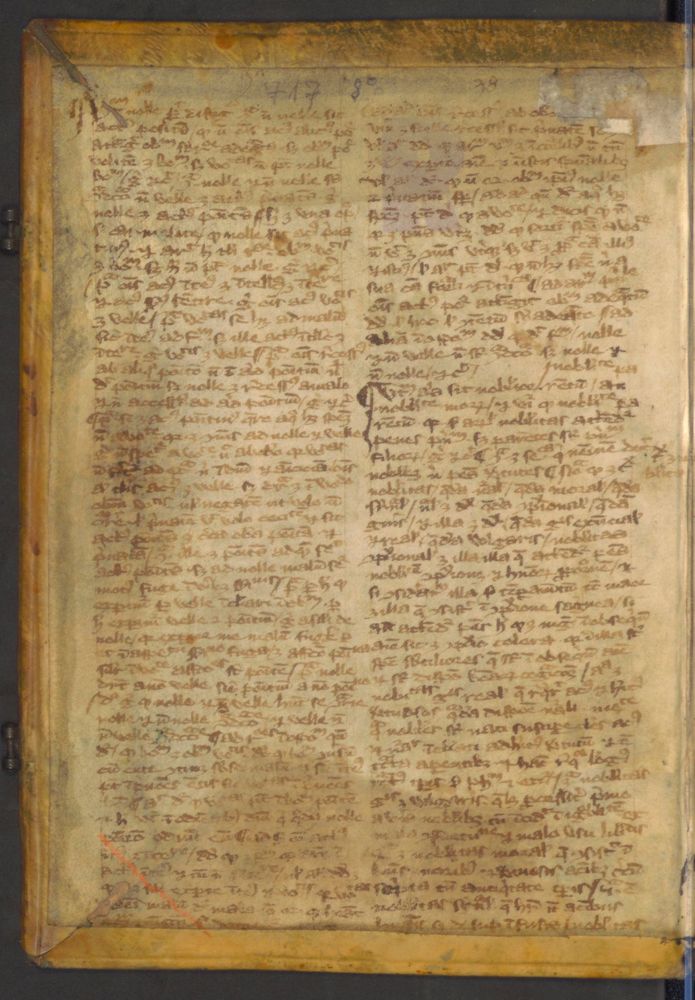
On Nobility and Virtue: The First Fragment in the First Edition of a 1525 Print
Material : Parchment
Place of origin : Unknown
Language : Latin
Date of origin : circa 1400
Number of hands : 1
Content : Questions about the nobility and its moral aspect
Measurements : 190 x 140/145 mm
There are two leaves and three pages in parchment, written in Latin by only one hand and dated by the digi-hub in 1400. The format is 190 x 140/145 mm, with worm holes, staining and fading on the pages.
This fragment seems to ask questions about the nobility and the moral aspect of it.
The first fragment has been found glued to the front of the wooden binding of the AntiLutherus Judoci Clichtouei Neoportuensis, Doctoris Theologi, Academiae Parrhisie[n]sis, Tres libros co[m]plecte[n]s : Primus, contra effrenem uiuendi licentia[m], ... Secundus, contra abrogatione[m] missae, ... Tertius, co[n]tra eneruatione[m] uotor[um] monasticor[um], by Josse Clicthove in 1525, edited by Peter Quentel in Paris.
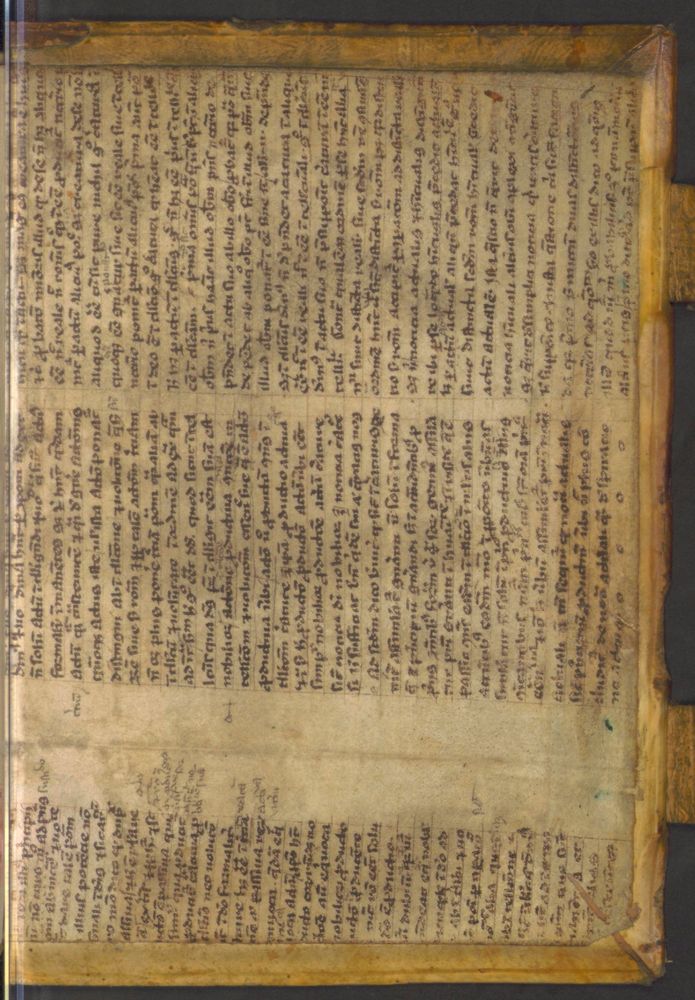
God’s Action and Human Understanding: The Second Fragment Found in the First Edition of a 1525 Print
Material : Parchment
Place of origin : Unknown
Language : Latin
Date of origin : circa 1400
Number of hands : 1
Content : About the nature of God's actions
Measurements : 200 x 165 mm
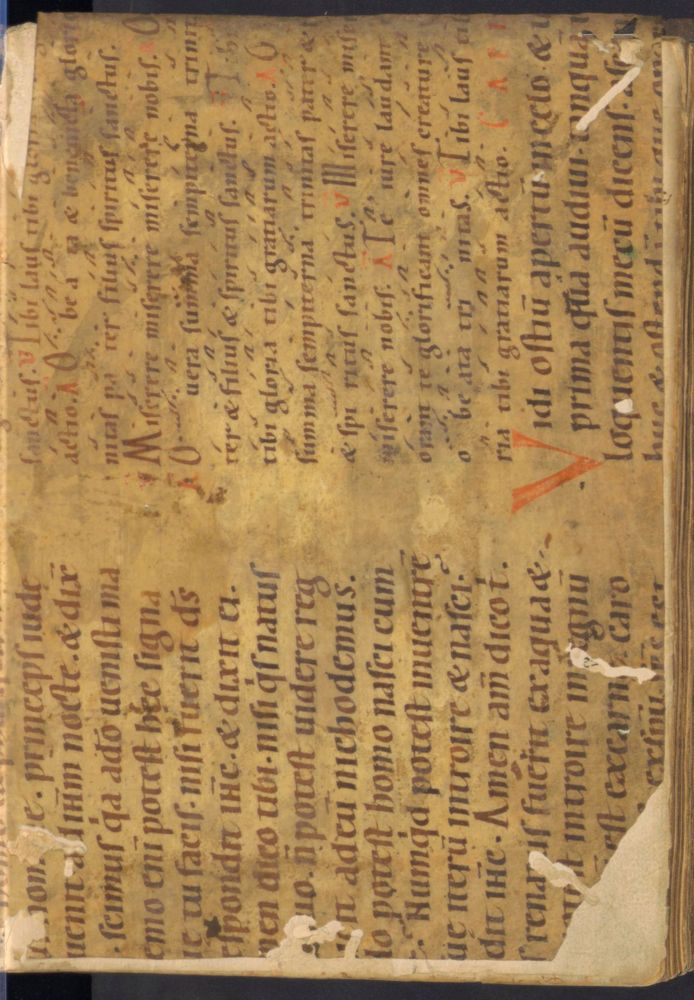
The second fragment has been found glued to the back of the wooden binding of the book registered as 717 in octavo format, AntiLutherus Judoci Clichtouei Neoportuensis, Doctoris Theologi, Academiae Parrhisie[n]sis, Tres libros co[m]plecte[n]s : Primus, contra effrenem uiuendi licentia[m], ... Secundus, contra abrogatione[m] missae, ... Tertius, co[n]tra eneruatione[m] uotor[um] monasticor[um], by Josse Clicthove in 1525, edited by Peter Quentel in Paris.
There are one leaf and one page in parchment, written in latin by only one hand and dated by the digi-hub in 1400. The format is 200 x 165 mm, with worm holes, staining and fading on the pages. The page is readable by turning the book at 90°, meaning the original page was too big for the octavo format, hence the fact that a piece of the parchment has been looped in a folio.
This fragment is about the nature of God's actions, whether they are immanent or transient. It asks the question of the primacy of the thing or the thought.
Don't judge the book by its cover! Except in this case...
Date: 12th century
Place: unknown
Material: Parchment
Language: Latin
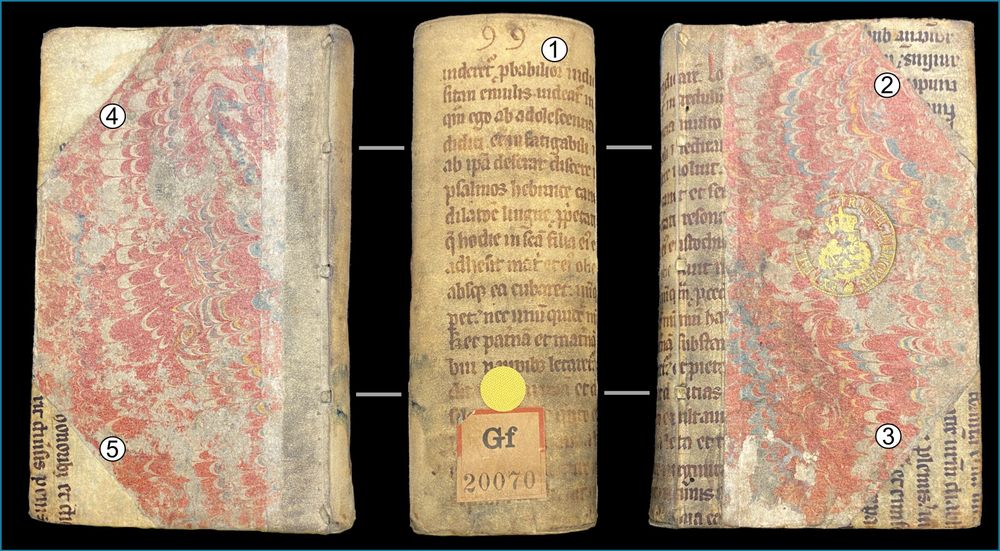
At first glance, this book (Berlin, Universitätbibliothek der Humboldt-Universität zu Berlin, GF 20070) already seems unusual. The content of the pages themselves are representative of a typical 17th century book, printed in Hanau (Hanoviae), Germany, by the printer Guilielmus Antonius. However the book cover is composed partially of several medieval manuscript fragments.
A total of five in situ fragments can be seen on both sides of the cover: Fragm. 1 is the essential part of the bookbinding; Fragm. 2 is the upside-down fragment on the upper right corner of the front cover; Fragm. 3 is the fragment on the lower right corner of the front cover; Fragm. 4 is the small fragment on the upper left corner of the back cover; Fragm. 5 is the small fragment on the lower left corner of the back cover. They display different orientations of the text, reflecting their complex integration into the book binding.
The observed cover is interesting for the recycling practices and changing meaning of materiality from a longue duree perspective. These in situ fragments were probably part of two different medieval manuscripts, written on parchment in gothica textualis: Fragm. 1 is an excerpt from a 12th century manuscript which contains a letter of St. Jerome addressed to Eustochium, the daughter of St. Paula (5th century), whereas Fragm. 2 to Fragm. 5 are excerpts from a 12th century manuscript which contains the lives of the martyrs Olympias and Maximus, as described in the hagiography of St.Laurent.
While a significant part was taken from the first manuscript to complete the binding (Fragm. 1), a passage from the second manuscript (Fragm. 2 to Fragm. 5) was completely cut and dispatched in the corners of the cover. There is an attempt to reconstruct the passage with the fragments transcription:
Fragm. 5: “honoribus et di/ rit diversis penis/ Respondit/”
Fragm. 3: “tormenta … …/ tiem vestrum diabl/ plenus. In et eun…/ pa/
Fragm. 2: “fin/ rundi/ anisius/ jacuerunt qu/”
Vitellius Anisius dixit ad eos? Cognitum est uobis, quid iusserit praecellentissimus Decius Caesar, ut siquis sacrificauerit, et custodierit praecepta Principum, honoretur et sit amicus Principum, et ditetur diuitiis et honoribus et dignitatibus: qui uero non consenserit, diuersis poenis tormentorum maceratus exhalet. Respondit Maximus et dixit: Tormenta uestra momentanea sunt et cito transeunt: sed et uos ipsi postea exhalabitis. Nos tormenta uestra non pauescimus sed desideramus: capitibus securi tunsis moriuntur: nam tormenta aeterna metuimus, quae uos torquere habent cum patre uestro diabolo. Vitellius Anisius Vicarius furore plenus, iussit ut cum securibus capita tunderentur. Et cum diu caederentur emiserunt spiritum. Et iussit Vitellius Anisius, ut corpora eorum canibus relinquerentur: corpora a canibus illaesa sepeliuntur. ubi etiam iacuerunt quinque diebus.
Ioannes Bollandus, Godefridus Henschenius (ed.), Acta Sanctorum, Michael Cnobarus, Antwerp, 1675, XV Aprilis, "De SS. Olympiade et Maximo martyribus cordiale in Perside", Commentarius "Olympiades, Martyr, Cordiale in Perside (S.) Maximus, Martyr, Cordulae in Perside (S.), 375C-375D.
URL : https://mlat.uzh.ch/browser/23457:5
If we compare the full passage with the observed visible text, we can see that the non-visible gaps are not substantial. This could imply the employment of two columns on the original manuscript page.
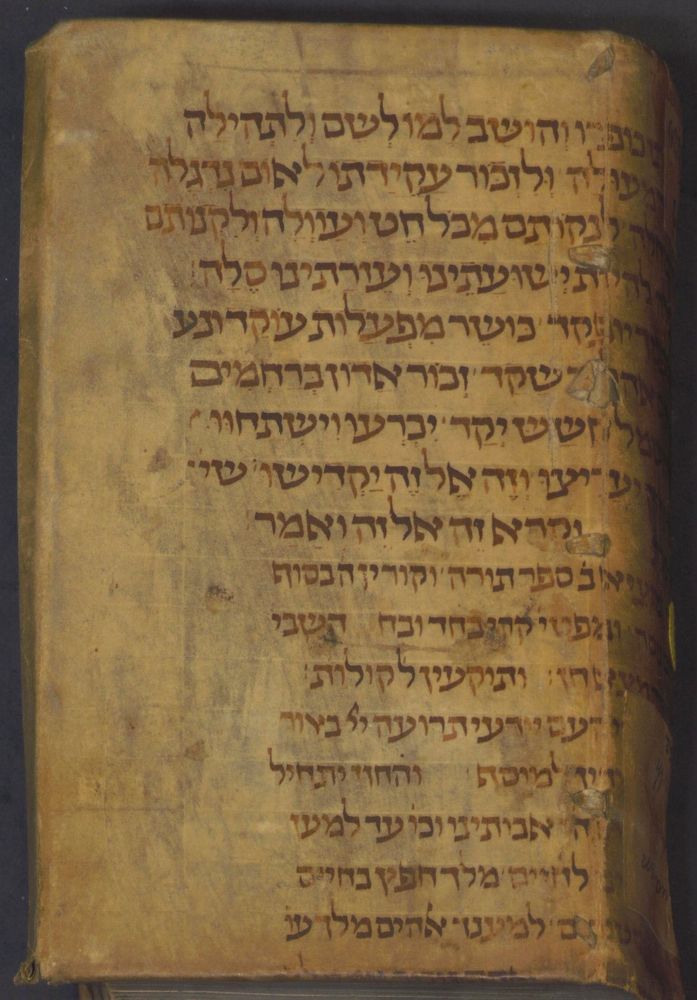
Hebrew Liturgy, Latin Poetry
Material: Parchment
Place of origin: Unknown
Language: Hebrew
Date of origin: 13th century
Content: Liturgy for the second day of Rosh Hashanah (Jewish New Year), and an unidentified text
This fragment consists of part of a parchment bifolio dating from the thirteenth century. The Hebrew text is written in an Ashkenazi script, characteristic of the Jewish communities of medieval Central and Western Europe. Despite its fragmentary condition, the manuscript preserves portions of the liturgy for the second day of Rosh Hashanah, the Jewish New Year.
Alongside the liturgical text, the fragment contains an additional section that has not yet been identified. The surviving leaves therefore provide valuable evidence for the transmission of Hebrew religious texts in medieval Europe, and reflects the multilingual and multicultural environment of medieval Europe.
A Different Kind of Singing
Material: Parchment
Place of Origin: Central Europe
Language: Latin
Date of Origin: late 12th century
Script: Late Carolignian minuscule
Content: Passages from the Evangelium secundum Iohannem 3, 1-5, chants used in the Office of the Feast of the Holy Trinity, and the beginning of the Apocalypsis 4, 1
This parchment fragment originates from a liturgical manuscript produced in Central Europe during the late twelfth century. This particular piece has been later reused and cropped to fit in the binding of a composite volume containing two editions of Sebastian Brant’s Stultifera Navis or the Ship of Fools (printed in Basel, 1497 and 1506/1507).
Fortunately, the cropping does not impair the readability of the fragment. If one looks attentively, traces of ruling for both lines and columns are visible, providing insight into the careful planning and layout techniques employed by medieval scribes to ensure a clean and proper text.
This fragment is a beautiful example of the use of rubrics, textual elements written in red ink to highlight the important sections of the text. The name derives from the latin ruber, meaning "red". We can see the letters "A", "V", and "R" (antiphona, versiculum and responsorium) as well as the Capitulum, or chapter header.
Of particular interest is the paragraph in the upper left corner of the fragment. It contains the chant De Trinitate, notated in the German neume system, characteristic of Central Europe around the turn of the 13th century. The musical notation is written above the text without staff lines, representing an earlier stage in the development of Western European musical notation. We may think it very different from our current notation system.
The text appears to have been intended for use during the morning celebration of the Divine Office in the period following Easter, on the day of the Feast of the Holy Trinity. The red initials marked "A","R" and "V", indicate the system of alternating chants and responses between the officiant and the choir during the Divine Office.
The liturgical features of this fragment allow it to be identified as a part of a breviary, a book used to guide the officiants during the Divine Office.
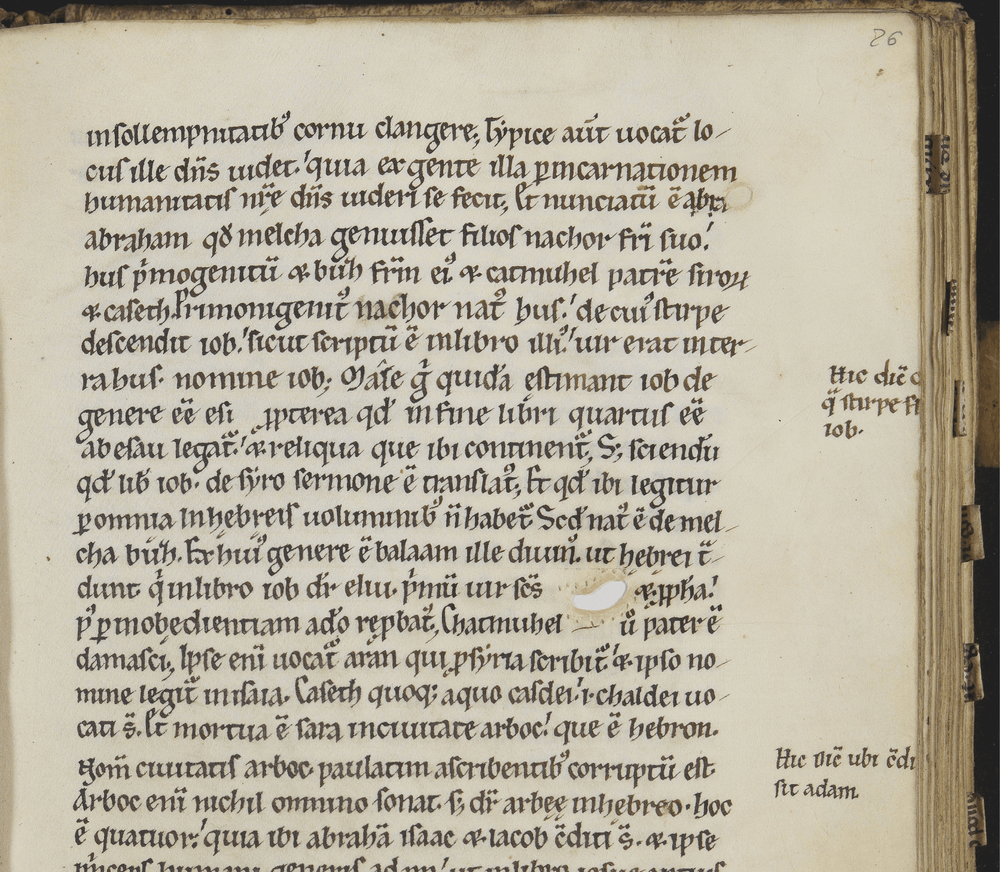
Marginal comments were cut when preparing a new binding
Call Number: Hs. 2008 B 113
Institution: Universitätsbibliothek der Humboldt-Universität zu Berlin
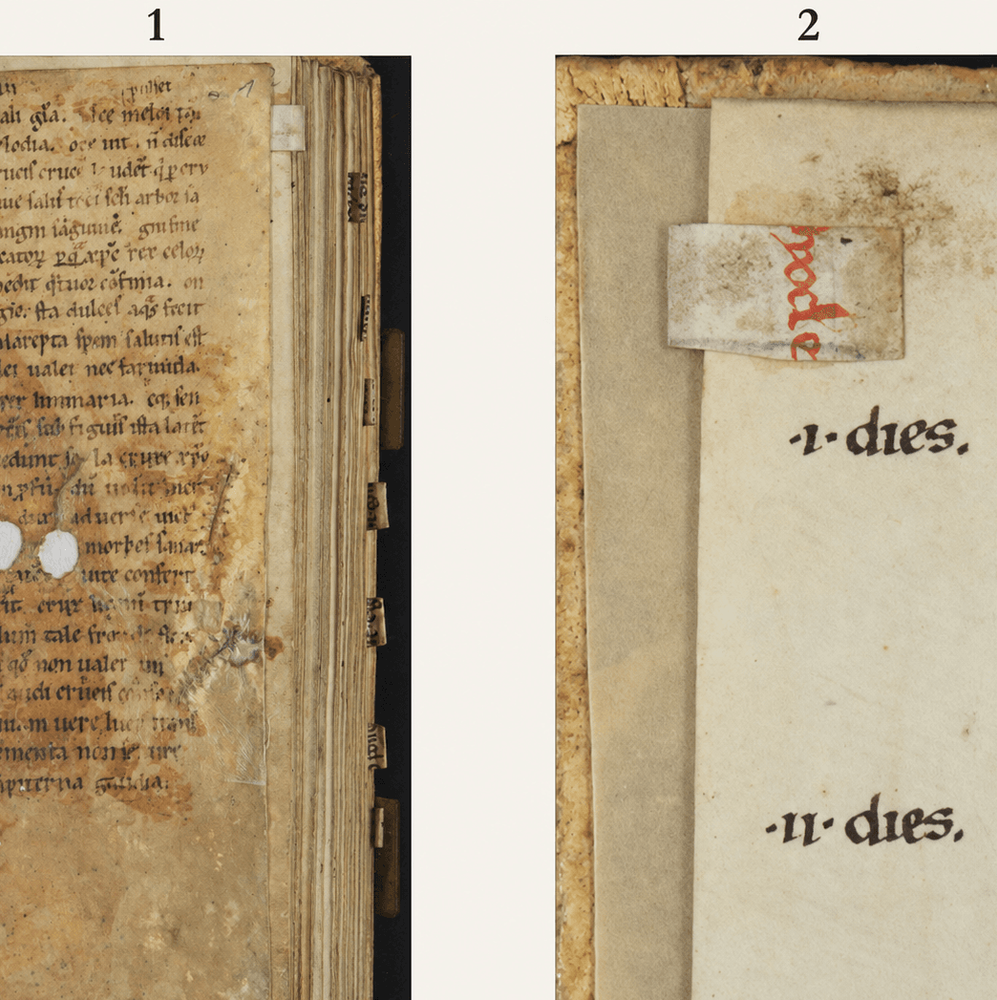
Placeholders Made from “Recycled” Parchment Fragments
Ms. 2008 B 113 (Incipit exposicio super Octateucum) is a well-preserved codex that consists of a neatly written copy of the commentaries on the Octateuch (the first eight Biblical books) and several shorter religious texts. The volume, however, also contains a curious fragmentary addition: eight placeholders at the beginning of each book attached to the outer side of each designated folio. The function of the eight small strips was to help the reader navigate the text. We do not know why a material as precious as parchment was recycled in this way and not, for example, as an incunabulum. One could guess the text it supported was no longer relevant, either because a newer copy or newer translation was available, or the support was irreversibly damaged.
Since all of the manuscript folios have been cut to fit the later binding, yet the placeholders stayed, it is safe to assume that they were only added afterwards. Exact dating of the modification is unclear. Due to the uniformity of the writing, it is likely that they were cut from the same piece of parchment, the identity of which is unclear. Although most of the letters on these fragments are legible, the Latin words constructed by them can only be made out partially. After transcribing them, we were able to attempt reconstructing some words that could subsequently lead to the identification of the original text by limiting the options to those, in which the words occur.
This alone would lead to a multitude of possibilities, but, fortunately enough, the first placeholder (f. 2v, here on picture 2) offers a very useful clue. This fragment contains an incomplete word written in red, containing the letter cluster ”yocle.” If the preceding letter was indeed d, as we assumed, the original word could have been a variant of the name Diocletianus, spelt with y. This form of the name indeed appears in Medieval writing, for example, there are at least ten occurrences in Legenda Aurea variants. One possibility is, that the original parchment contained a hagiography, such as Passio sanctorum Cosmae et Damiani, qui passi sunt in civitate Egea sub Diocletiano et Maximiano Vo kalendas octobris (“The Passion of the saints Cosmas and Damian which happened in the city of Egea under Diocletian and Maximian during the Calends of October”) in Ms. Latin 3809A (Bibliothèque nationale de France). Given that one of the other legible letter clusters on the fragments was “arab,” the Arab saints Cosmas and Damian could indeed be likely candidates. Thus, the incomplete word in red ink would be either an incipit or a rubric marking the presence of the narration within a folio.
A Breviary Fragment in the Binding of Sermones Gabrielis de Vita Christi
Material: Parchment
Place of origin: German-speaking area (probable)
Language: Latin
Date of origin: circa 1400
Number of hands: 1
Content: Antiphons, responsories, verses for the Fourth Sunday after Easter; readings from 1 John (2:7-12) and James (1:18-24)
Measurements: 150 × 210 mm (each bifolio)
The fragments were found glued on the binding of the Sermones Gabrielis vitatibus Christi by Gabriel Biel, printed by Johann Otmar in Tübingen around 1499 (shelfmark 2004 A 1544).
The object consists of two parchment bifolios written in gothica textura by a single hand. The fragments probably originate from the same breviary, dated to around 1400 and likely produced in the German-speaking region.
Both bifolios must have been located close to one another in the original manuscript, as they both contain antiphons, responsories, and verses from the Divine Office for the Fourth Sunday after Easter. The fragments also contain passages from the Epistles of John and Jacob, namely 1 John 2:7-12 and 1 Jacob 18, 29-21 and 22-24.
On the margin of the second bifolio, attached to the back board of the host volume, appears the inscription: “In omnem terram exivit sonus eorum” (Psalm 18:5). This later reuse brought together two different stages of book culture: a medieval liturgical manuscript and an early printed edition of Sermones Gabrielis de vita Christi.